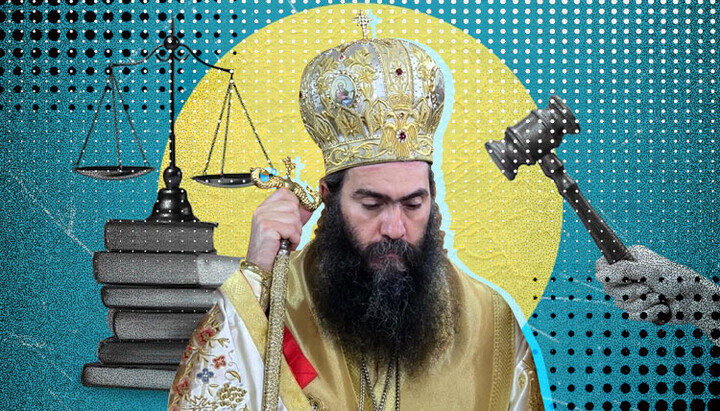
There are striking and undeniable parallels between the trial of Pilate and the trial of Metropolitan Tychikos.
To many, the story of Christ's trial may seem so ancient, so distant, that its repetition in our time appears impossible. After all, we live in a different reality, within a different system of values, where justice and truth, one would think, have a greater right to exist than they did two thousand years ago. Yet the entire history of the Church demonstrates that the condemnation of the Savior is not an archaic episode but an archetype – a story that repeats itself through the centuries.
Formally, Christ was condemned by the Roman authority in the person of Pontius Pilate, who found no guilt in Him yet succumbed to the pressure of the Pharisees and ordered the Galilean to be crucified – first washing his hands. And in imitation of Pilate, many rulers through the ages have done likewise – turning a blind eye to obvious injustice, thereby supporting persecutions, sham trials, and the shedding of innocent blood.
We in no way equate Metropolitan Tychikos with Christ. Yet the parallels between the trial of the Savior and the trial of this Cypriot hierarch are far too many to ignore. Still, this case bears one unique distinction: it was not Pilate who washed his hands, but the Church itself – in the person of the Ecumenical Patriarchate.
Part I. The Trial of Truth
"And judgment is turned away backward, and justice standeth afar off: for truth is fallen in the street, and equity cannot enter." (Isaiah 59:14)
In the spring of 2025, an event occurred in the life of the Church of Cyprus that many priests and laypeople saw as a sign of spiritual crisis: the suspension of Metropolitan Tychikos of Paphos from the governance of his eparchy.
The decision, adopted by the Holy Synod of the Church of Cyprus, caused bewilderment and deep protest among those who knew the hierarch personally – as a monk of rare purity, a man of prayer and meekness, a pastor who had, in a short time, breathed new life into the Paphos Metropolis.
Above all, this case became a litmus test for the entire contemporary Church. It revealed how easily the administrative machine can replace the living Body of Christ; how the Church can turn into a mere "organization"; how the holy canons can be twisted into tools of manipulation and political convenience instead of being instruments of truth.
Groundless accusations
Metropolitan Tychikos was removed from his eparchy in May 2025 – formally on charges of "canonical violations" and "poor administration." In reality, the accusations were so trivial that the very list of "offenses" resembled a document from the Pharisaic era, when the desire to condemn outweighed any sense of justice, and the letter of the law was wielded against its spirit.
He was accused of four "crimes": ordaining a "non-commemorating" priest, who, while still living in Greece as a layman, had ceased commemorating his bishop; refusing to perform a wedding for a Protestant woman who had recently joined Orthodoxy in the United States – not even a refusal, in fact, but a request to speak with her personally before the sacrament to ensure proper catechesis; consecrating a church in honor of an uncanonized ascetic (an accusation later disproved by a video showing Metropolitan Tychikos clearly naming the temple after St. Nectarios of Aegina); refusing to accept relics of the Apostle Paul brought by a Catholic cardinal and maintaining a generally critical stance toward Roman Catholicism and ecumenism.
Each of these points, on closer inspection, not only fails to demonstrate guilt but in fact reveals the Metropolitan's fidelity to Orthodox tradition. Yet the indictment stood. It was hastily submitted to the Synod, reviewed, and confirmed within a few hours.
According to the Charter of the Church of Cyprus, the trial of a hierarch must include defense counsel, access to case materials, and the right of appeal. None of these provisions were observed. The Synod acted hastily and behind closed doors, contrary to its own Charter, which, as Cypriot canonists noted, was "trampled underfoot for the sake of demonstrating unity of authority."
The appeal to the Phanar
When the case reached the Ecumenical Patriarchate, many hoped that justice would prevail. The appeal was accepted, for the grounds were evident. After internal review, the Patriarchal Synod decided to summon the Metropolitan to the Phanar for personal participation in the final examination of his case.
It took three months for this decision to be made. The Synod Fathers were divided – many believed Tychikos had been condemned unjustly. The final communiqué even acknowledged that "procedural irregularities" had occurred in Nicosia. Yet despite acknowledging these violations, the decision was upheld "for the sake of peace," urging the Metropolitan to submit "for his own spiritual benefit."
In doing so, the Phanar acted not according to canon law but to diplomatic calculation, unwilling to offend Archbishop Georgios, who supports the Phanar's recognition of the OCU and whose Church provides it with substantial financial assistance.
Part II. When the Church "Washes Its Hands"
"For judgment is without mercy to the one who has shown no mercy." (James 2:13)
When the Phanar confirmed the decision of the Cypriot Synod – despite admitting the procedural violations – many perceived this as a moment of truth for the modern Orthodox world. The truth, however, proved bitter.
The Ecumenical Patriarchate, which should be the last refuge of justice in inter-church conflicts, chose instead the role of Pontius Pilate: to acknowledge innocence – and to wash its hands.
A sign of the times
The figure of Metropolitan Tychikos has transcended his own story. He has become a symbol of fidelity colliding with administrative and political expediency – a sign of our age, when the Church again faces the temptation of power, seeking to negotiate with the world by diplomacy rather than by Gospel witness.
Metropolitan Tychikos is by no means an "opposition figure" or an activist. He is a man of prayer, who has suffered for his fidelity to the canons of the Church. He reminds us that true spiritual life begins not with agreement with authority, not with compromise of conscience, nor with political or national calculation, but with obedience to God.
"And ye shall know the truth, and the truth shall make you free." (John 8:32)